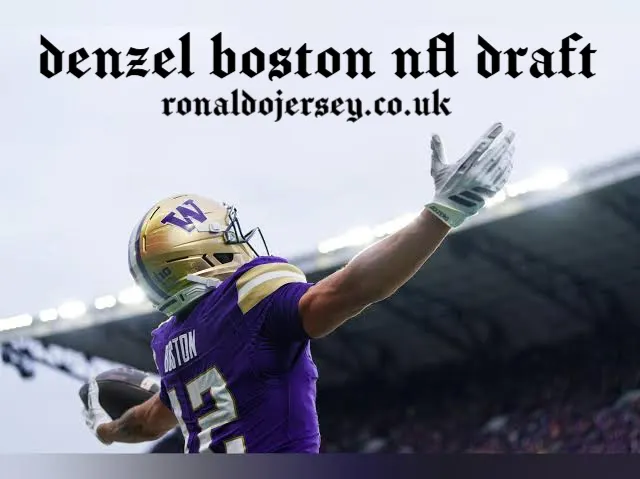
The Denzel Boston NFL Draft story took an interesting turn in 2026. The former Washington Huskies wide receiver was widely discussed as a potential Day 2 target for the Las Vegas Raiders, particularly because of his size, red-zone ability and potential as an X receiver.
But the Raiders ultimately went in another direction.
Cleveland selected Boston with the No. 39 overall pick in the second round, while Las Vegas traded its original No. 36 selection to Houston before moving back to No. 38. The Raiders selected Arizona safety Treydan Stukes at that spot.
That makes Boston’s Raiders connection a what-if draft scenario rather than a current roster connection.
It is still worth examining because Boston’s skill set addressed a need that Las Vegas had identified before the draft: a large outside receiver capable of winning at the catch point and becoming a red-zone target.
And there was one major warning attached to the prospect: separation and verified speed.
Who Is Denzel Boston?
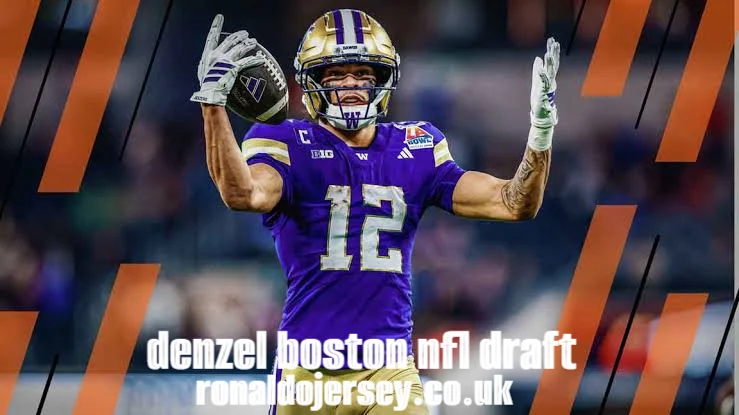
Denzel Boston is a 6-foot-4 wide receiver from Washington who entered the 2026 NFL Draft after four seasons with the Huskies.
He developed from a relatively limited role behind NFL receivers such as Rome Odunze, Jalen McMillan and Ja’Lynn Polk into Washington’s leading receiver during his final two seasons.
Boston finished his Washington career with:
| Category | Career |
|---|---|
| Games | 43 |
| Receptions | 132 |
| Receiving yards | 1,781 |
| Yards per reception | 13.5 |
| Receiving TDs | 20 |
His final two seasons were particularly productive. He caught 63 passes for 834 yards and nine touchdowns in 2024, followed by 62 catches for 881 yards and 11 touchdowns in 2025.
Cleveland ultimately selected him 39th overall, giving Boston an opportunity to prove his contested-catch profile against NFL defensive backs.
What Made Denzel Boston an Intriguing NFL Prospect?
The clearest answer is simple: Boston gives an offense a big target who can win without needing a perfectly thrown pass.
His 6-foot-4 frame, long arms, strong hands and body control allow him to compete for throws that smaller receivers may not be able to reach.
Scouting evaluations consistently identified his ball skills and contested-catch ability as major strengths. PFF also highlighted his release variety, route fluidity for his size, catch radius and ability to contribute after the catch.
Boston’s profile therefore made sense for teams searching for a traditional X receiver.
He could line up outside, use his frame against press coverage, work back-shoulder throws, attack the boundary and become a valuable red-zone target.
His biggest strengths include:
- 6-foot-4 frame and substantial catch radius
- Strong hands
- Excellent body control
- Contested-catch ability
- Red-zone potential
- Ability to track the football vertically
- Physical play after the catch
- Experience against press coverage
- Useful route-running intelligence
- Willingness and ability to contribute as a blocker
Sports Info Solutions similarly noted Boston’s contested-catch reliability, ball tracking and route diversity while identifying explosiveness out of breaks as an area for improvement.
Denzel Boston’s Biggest Warning: Separation
The biggest concern surrounding Boston entering the NFL was not his hands.
It was how consistently he could separate from NFL cornerbacks.
Boston is not generally viewed as a sudden, explosive receiver who routinely creates several yards of immediate separation with his release and route breaks.
NFL.com’s draft analysis specifically identified his lack of a second gear and separation ability as concerns. The same evaluation noted that Boston did not run the 40-yard dash at either the NFL Scouting Combine or his pro day.
That matters because NFL defensive backs close space much faster than most college defenders.
A receiver who wins primarily through size, leverage and late separation has less margin for error against NFL man coverage.
This does not mean Boston cannot separate.
Rather, his separation tends to come differently from that of a smaller speed receiver.
He can create space by:
- Using his frame to shield defenders.
- Winning leverage.
- Varying his route tempo.
- Using physicality through the route.
- Creating separation late rather than immediately.
- Exploiting zone coverage and soft spots.
The Ringer’s draft profile similarly praised Boston’s route-running savvy and contested catches while pointing to his gearing down before breaks and limited acceleration out of cuts as weaknesses.
That is the central question surrounding his NFL ceiling.
Is Denzel Boston Fast Enough for the NFL?
There is no official NFL Scouting Combine 40-yard-dash time for Boston.
He did not run the event at the Combine or at his Washington pro day, so any precise 40-yard number circulating online should be treated carefully rather than presented as an official measurement. NFL.com specifically noted the absence of a 40 time when discussing his draft profile.
That omission became part of his scouting discussion because Boston’s game does not depend on elite acceleration.
He is better described as a long-striding, big-bodied receiver than a pure burner.
His vertical effectiveness comes from a combination of size, stride length, route pacing, ball tracking and catch-point ability.
That distinction is important.
A receiver does not need to run a 4.3-second 40 to become a productive NFL player. But Boston will have to demonstrate that he can create enough functional separation against professional coverage to prevent defenses from simply contesting every target.
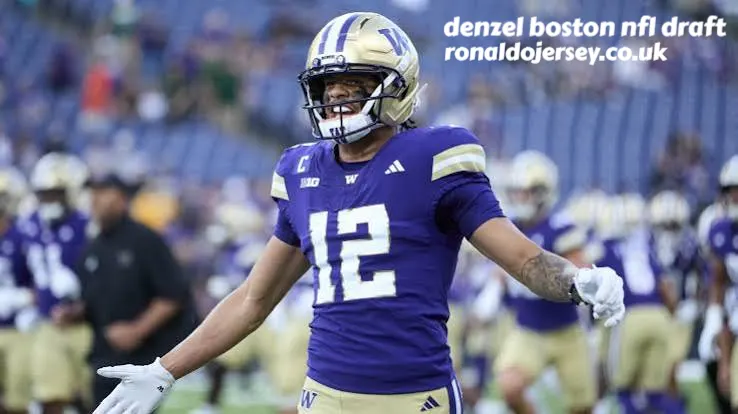
Denzel Boston’s Route Running and Hands
Boston’s route running is more advanced than his lack of elite explosiveness might suggest.
He has experience running:
- Slants
- Crossers
- Curls
- Posts
- Corner routes
- Back-shoulder routes
- Double moves
- Screens
- Intermediate in-breaking routes
PFF praised his ability to use multiple releases and his route fluidity for a receiver of his size.
His hands are another major selling point.
PFF credited him with only five career drops in one draft evaluation, while its 2025 data showed Boston with just one charged drop on 86 targets.
That combination of size and reliable hands explains why teams could view him as more than a simple 50/50-ball specialist.
Denzel Boston’s College Production
Boston’s production accelerated dramatically once he became a starter.
His 2024 season produced 63 receptions, 834 yards and nine touchdowns.
In 2025, he followed with 62 receptions, 881 yards and 11 touchdowns. His 14.2 yards per reception showed that he was not merely functioning as a short-area possession receiver.
His final Washington season also included several explosive performances, including 153 receiving yards against Illinois and 126 yards against Boise State in the LA Bowl.
Those performances reinforced the idea that Boston could create explosive plays despite not being considered an elite pure-speed prospect.
Why Did Denzel Boston Fit the Raiders Before the Draft?
This is where the Denzel Boston Raiders connection made sense.
Before the 2026 draft, Las Vegas had a young receiving group featuring players such as Tre Tucker and Jack Bech, while Jalen Nailor was added in free agency.
Raiders.com explicitly listed Boston among potential second- or third-round receiver options in an April 15 draft discussion.
ESPN also identified Boston as a potential fit because the Raiders were looking for a larger outside receiver capable of playing the X position and contributing in the red zone.
That was particularly relevant because Las Vegas had just selected quarterback Fernando Mendoza No. 1 overall.
The theoretical pairing was easy to understand:
Mendoza’s arm + Boston’s catch radius + back-shoulder throws + red-zone size
could have created an interesting offensive combination.
But that chemistry remains hypothetical because Boston went to Cleveland.
What Happened to the Raiders’ No. 36 Pick?
This is an important correction for anyone searching for Denzel Boston Raiders second round information.
The Raiders originally held No. 36 overall.
On April 24, however, Las Vegas traded No. 36 and No. 117 to Houston in exchange for No. 38 and No. 91.
Houston used No. 36 to select Ohio State defensive tackle Kayden McDonald.
Las Vegas then used No. 38 on Arizona safety Treydan Stukes.
So Denzel Boston was never the Raiders’ No. 36 pick, and he is not currently a Las Vegas Raiders wide receiver.
What Does Boston’s Early NFL Career Tell Us?
As of October 2, 2026, Boston has already provided some evidence that his college strengths can translate.
Through four regular-season games, he has recorded 13 receptions for 284 yards and two touchdowns, including a 60-yard reception against Pittsburgh on October 1.
His first four games:
- Jaguars: 2 receptions, 59 yards, 1 TD
- Buccaneers: 5 receptions, 95 yards, 1 TD
- Panthers: 2 receptions, 41 yards
- Steelers: 4 receptions, 89 yards
That gives him an early average of 21.8 yards per reception, although four games are far too small a sample to make definitive conclusions about his long-term NFL ceiling.
The early numbers are nonetheless notable because they demonstrate that his size-and-catch-point profile has not prevented him from producing explosive plays at the professional level.
What About the Raiders’ Wide Receiver Room Now?
The Raiders’ current receiving room is different from the one that existed before the draft.
The official Las Vegas depth chart lists Jalen Nailor, Tre Tucker and Malik Benson among its primary receivers, with Jack Bech also part of the group.
Las Vegas ultimately drafted only one wide receiver in 2026: Malik Benson, according to general manager John Spytek’s post-draft comments. Spytek also expressed confidence in Tucker, Bech, Nailor and other young receivers.
That decision matters when evaluating the old Denzel Boston Raiders rumors.
Boston clearly fit a positional need identified before the draft, but the Raiders’ front office chose to allocate its premium draft capital elsewhere.
Denzel Boston NFL Comparison
Boston’s most common stylistic comparisons center on large, physical NFL receivers.
NFL.com’s draft analysis referenced a mold similar to Mike Evans and Nico Collins, while The Ringer compared his overall style to Courtland Sutton and Michael Pittman Jr.
The comparisons should not be interpreted as predictions that Boston will achieve those players’ careers.
Instead, they describe the type of receiver he was projected to become:
large frame + strong hands + physicality + contested catches + boundary presence.
His developmental challenge is producing enough separation to complement those traits.
Denzel Boston NFL Draft Projection: What Was the Verdict?
Boston’s pre-draft projection ultimately landed in the exact area many evaluators expected: early Round 2.
The Cleveland Browns selected him No. 39 overall, five picks after the Raiders’ original No. 36 selection.
That draft position reflected the balance of his profile.
The upside
- Starting-caliber X receiver potential
- Exceptional size
- Strong hands
- Red-zone mismatch potential
- Contested-catch ability
- Functional route-running intelligence
- Vertical tracking
- Physicality
The warning signs
- Unproven timed speed
- No official 40-yard dash
- Limited explosive acceleration
- Separation against man coverage
- Less suddenness at route breaks
- Potential difficulty consistently creating immediate space
The result is a receiver with a fairly clear NFL identity but also a clear developmental question.
source: NFL.com
Custom FAQs
What are Denzel Boston’s college stats?
Denzel Boston finished his Washington career with 132 receptions for 1,781 yards and 20 receiving touchdowns in 43 games. His final two seasons produced 63 catches for 834 yards and nine touchdowns in 2024, followed by 62 catches for 881 yards and 11 touchdowns in 2025.
Is Denzel Boston related to David Boston?
No. Denzel Boston is not related to former NFL receiver David Boston. Denzel’s father is Chris Boston. A mistaken broadcast identification during the 2026 NFL Draft led to additional attention around the question.
What is Denzel Boston’s NFL comparison?
Boston has been compared stylistically with large, physical receivers such as Mike Evans, Nico Collins, Courtland Sutton and Michael Pittman Jr. These comparisons describe aspects of his playing style rather than guaranteed career outcomes.
What was Denzel Boston’s NFL Draft projection?
Boston was widely viewed as a late-first-round or early-second-round prospect. The Cleveland Browns ultimately selected him No. 39 overall in Round 2 of the 2026 NFL Draft.
What is Denzel Boston’s 40 time?
Boston does not have an official NFL Combine or pro-day 40-yard-dash time. He did not run the event at either workout, leaving his timed long-speed profile officially unverified.
Also Read