INTRODUCTION
You just received a Nike soccer jersey in the mail. The price was right. The colors look sharp. But something feels slightly off, and you are not sure what it is. That moment of doubt is exactly why you need to know how to identify official Nike soccer jerseys before you spend a single dollar.
Counterfeit soccer jerseys are flooding online marketplaces right now. According to the Organization for Economic Cooperation and Development, counterfeit sportswear accounts for billions in lost revenue every year. Nike is one of the most targeted brands in the world. Fake kits have become so convincing that even experienced buyers get tricked.
This guide gives you a clear, practical checklist to authenticate your kit. You will learn to read tags, inspect logos, test fabric, check stitching, and verify purchase channels. By the end, you will never question whether your jersey is real again. Let us get into it.
Why Knowing How to Identify Official Nike Soccer Jerseys Matters
Buying a fake jersey is not just a financial loss. It is a quality problem. Counterfeit kits use cheap polyester blends that trap sweat, fade quickly, and fall apart after a few washes. Authentic kits use Nike’s proprietary Dri-FIT or Dri-FIT ADV technology, which moves moisture away from your skin and keeps you cool during a match.
Beyond performance, fakes also hurt the clubs and athletes you support. When you buy counterfeit gear, the revenue does not reach the team or federation. And if you plan to resell the jersey, getting caught with a fake can permanently damage your reputation as a seller.
💡 Quick Fact
Nike releases two versions of most official soccer jerseys: the authentic match jersey worn by players, and the stadium replica for fans. Both are genuine. But only the authentic match version uses the full ADV construction with laser-cut ventilation and engineered fit.
Knowing how to identify official Nike soccer jerseys protects your money, your wardrobe, and your reputation as a smart buyer.
Start Here: The Hang Tag and Swing Tag Check
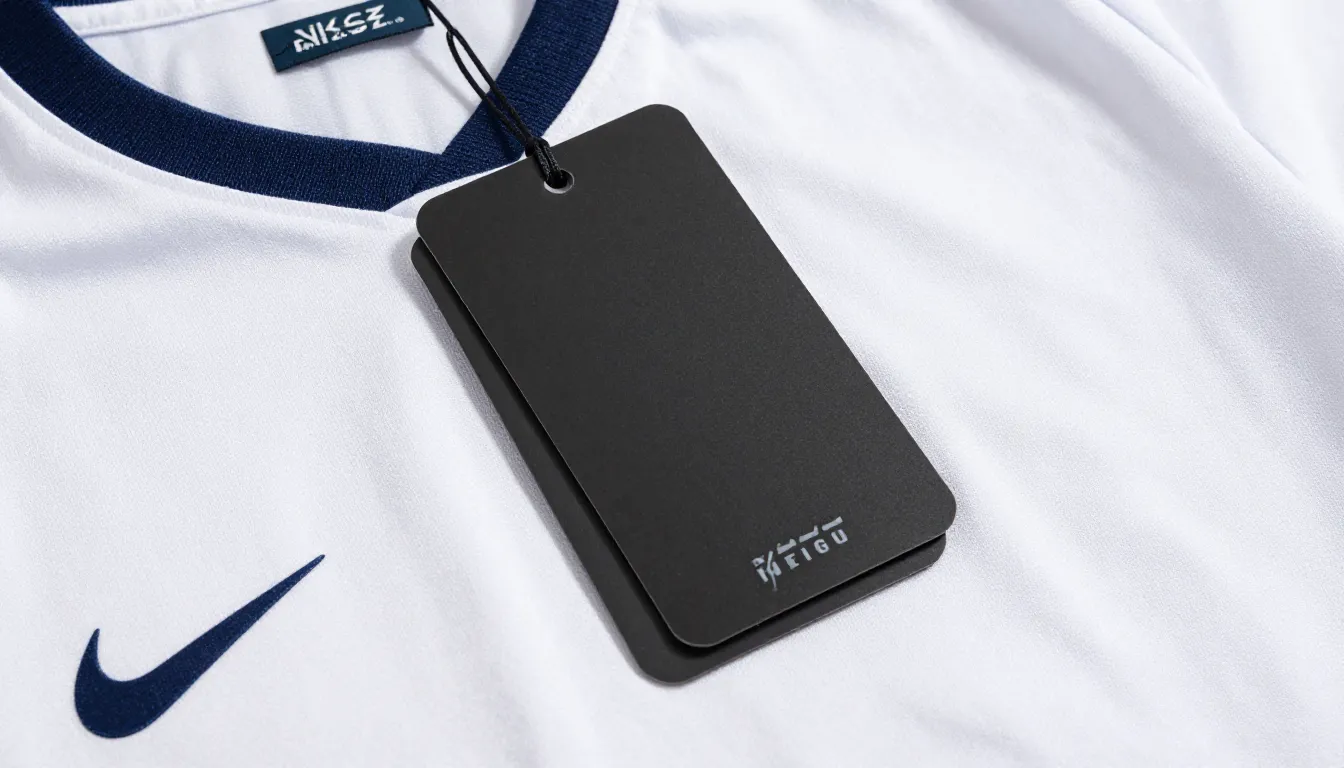
The first thing you should do when you receive a new Nike soccer jersey is look at the hang tags. Authentic jerseys always come with two tags attached by a plastic fastener. One tag shows the product name and size. The other shows the barcode, price, and care details.
What a Real Hang Tag Looks Like
- Clean, sharp printing with no smearing or blurry text
- A QR code or barcode that scans correctly on a barcode app
- Consistent fonts throughout, with no random spacing errors
- Nike’s exact brand name in the correct proprietary font
- Country of manufacture printed clearly, usually Vietnam or Indonesia
Fake jerseys often cut corners on tags. You will notice blurry text, inconsistent spacing, or logos that look slightly wrong. The Swoosh on a real hang tag has smooth edges and perfect proportions. On a fake, it might look thicker, sharper, or lopsided.
The Plastic Fastener Test
Nike uses a specific type of plastic tag fastener on all its products. It is rigid and uniform in thickness. Counterfeit jerseys often use cheap fasteners that bend easily, have uneven thickness, or feel hollow. It sounds like a small detail, but it is a fast and reliable indicator when you are learning how to identify official Nike soccer jerseys.
The Inner Label: Your Most Reliable Authentication Tool
Flip the jersey inside out. The inner label sewn into the collar or side seam is one of the strongest authentication points on any Nike product. Real jerseys have clean, flat labels with precise stitching on all four sides.
Key rule: On authentic Nike soccer jerseys, the inner label font is always crisp. The care symbols are standardized. The label never peels, bubbles, or feels papery. If the label looks like it was printed on thin paper and glued in, you are holding a fake.
What to Read on the Inner Label
- Material composition, such as 100% recycled polyester
- Country of manufacture matching the hang tag
- Style code that you can verify on Nike’s official website
- Care instructions using the correct international laundry symbols
You can take that style code and type it directly into Nike.com’s search bar. If the product appears, your jersey is almost certainly authentic. If nothing comes up, or the result does not match what you have, treat that as a major red flag.
Inspecting the Nike Swoosh: Details That Fakes Always Get Wrong
The Swoosh is the most iconic element on any Nike product, and it is also the most commonly faked. When you are learning how to identify official Nike soccer jerseys, pay close attention to every version of the Swoosh on the kit.
Chest Swoosh
On authentic jerseys, the chest Swoosh is either embroidered or heat-transferred with precision. The tail of the Swoosh tapers to a very fine point. The tick starts thin on the left and curves upward to a thicker body on the right. Fakes often make the tail too blunt, or the overall shape too symmetrical.
Heat-Transfer vs Embroidery
High-end authentic jerseys use embroidered Swooshes with tight, uniform thread counts. Budget-level replicas sometimes use heat-transfer, which is also used on genuine fan versions. The key difference is edge quality. Real heat-transfer logos have perfectly smooth edges. Fake versions show bubbling, rough edges, or lifting at the corners.
| Feature | Authentic Nike Jersey | Counterfeit Jersey |
|---|---|---|
| Swoosh tail tip | Very fine, tapered point | Blunt or too rounded |
| Label stitching | Tight, flat, 4-sided | Loose, raised, or glued |
| Dri-FIT texture | Porous, lightweight weave | Dense, slippery, or rough |
| Seam stitching | Consistent stitch density | Uneven, loose ends visible |
| Colors | Match official colorway exactly | Slightly off, washed out |
| Club badge | Licensed, clean detail | Blurry or incorrect design |
Fabric and Feel: How to Identify Official Nike Soccer Jerseys by Touch
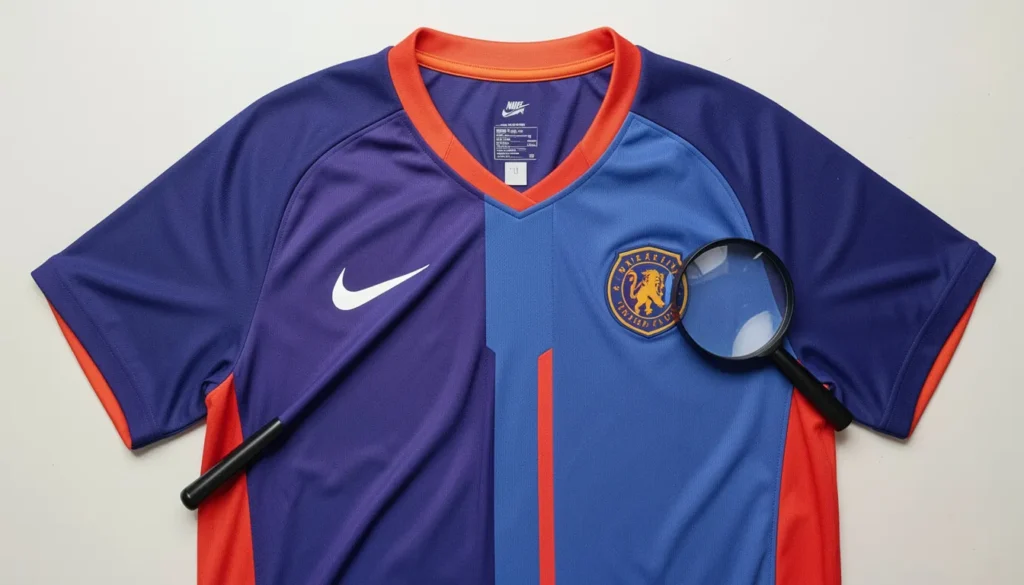
You can learn a lot about a jersey before you even look at it. Authentic Nike soccer jerseys have a distinct feel. The Dri-FIT fabric is lightweight, slightly textured, and has a subtle porous structure you can see when you hold it up to the light.
The Light Test
Hold the jersey fabric up toward a light source. On authentic Dri-FIT kits, you will see a fine mesh pattern of tiny perforations or a woven grid structure. This is the moisture-wicking construction working at a structural level. Fake jerseys usually use a flat, solid weave that does not have this grid pattern. The light passes through unevenly or barely at all.
Weight and Drape
Real Nike match jerseys are exceptionally light. When you hold a genuine jersey and let it drape over your hand, it falls smoothly with almost no resistance. Fake jerseys made from cheap polyester feel heavier, stiffer, or slightly plasticky. Some counterfeits even have a faint synthetic smell that authentic jerseys do not have.
I always run the fabric between my thumb and forefinger when checking a jersey. A real Nike kit feels almost like a second skin — cool, smooth, and barely there. If it feels like a thin shopping bag or heavy craft fabric, that is a warning sign.
Stitching and Construction: Where Fakes Fall Apart
Look at the stitching on every seam. This is one of the clearest ways to tell a real kit from a fake when you know how to identify official Nike soccer jerseys by construction quality.
Side Seams
Authentic jerseys use flatlock stitching on side seams. This means the seam lies completely flat against the body with no ridge or raised edge. This is done specifically to reduce irritation during athletic movement. Fake jerseys usually have standard overlocked seams with a visible raised ridge.
Collar and Neckline
The collar construction on authentic kits is precise and symmetrical. V-necks and crew necks maintain their shape even after washing. The rib-knit collar uses stretch fabric that returns to shape immediately. Counterfeit collars often look shapeless, sit unevenly, or stretch out permanently after one wear.
- Check that all stitch lines are straight and evenly spaced
- Pull gently on a seam and watch for loose threads or puckering
- Examine the collar join at the back of the neck for clean folding
- Inspect under the armhole where stitching is complex and detail-intensive
Club Badges and Sponsor Logos: Authenticity in the Details
Official Nike soccer jerseys for top clubs carry licensed club badges. These badges are embroidered with licensed thread colors and exact proportions controlled by the club. When you inspect the badge, zoom in on the fine details like thin lines, text within the crest, and gradient shading in embroidered sections.
Signs of a Fake Club Badge
- Blurry or pixelated fine text around the crest border
- Wrong shade of thread color compared to official club colors
- Missing details, such as tiny stars, founding year text, or motto
- Badge is slightly too large or too small for the chest placement
- Heat-transfer badge on a jersey that should have embroidery
Sponsor logos follow the same rule. If the jersey has a front-of-shirt sponsor, compare the logo shape, font, and color directly to the sponsor’s official brand guidelines. A fake will almost always get at least one element slightly wrong.
Where You Buy Makes All the Difference
Even the best authentication skills in the world cannot fully protect you if you are shopping in the wrong places. Knowing how to identify official Nike soccer jerseys starts with knowing where to look for them.
Safe Places to Buy
- Nike.com and Nike’s official retail stores worldwide
- Official club online stores such as nike.com/team sections
- Authorized Nike retailers like Dick’s Sporting Goods, JD Sports, and Foot Locker
- Official club physical stores at stadiums or branded outlets
High-Risk Platforms to Watch
Marketplaces like eBay, AliExpress, Wish, and some third-party Amazon sellers carry high volumes of counterfeit jerseys. That does not mean every listing is fake. But it means you must apply every authentication method in this guide before trusting a purchase from these platforms.
⚠️ Warning
If the price is 60% or more below retail, assume the jersey is fake until proven otherwise. Authentic Nike soccer jerseys are premium products. Real discounts exist during sales, but they rarely exceed 30 to 40 percent off retail price.
Using Nike’s Digital Tools to Verify Authenticity
Nike has invested in digital verification for many of its products. Some higher-end Nike items now carry NFC chips or QR codes that link to a product verification page. When you scan these with your smartphone, you land on an official Nike product page confirming the item’s authenticity.
Not all soccer jerseys include these features yet. But when they do, always scan the chip or code and verify the result before accepting a jersey as genuine. If the code does not scan, redirects to a non-Nike URL, or shows a product that does not match your item, treat it as a counterfeit.
You can also use Nike’s customer service to verify a style code. Contact Nike directly with the style number from the inner label and ask them to confirm it exists in their product catalog. This is a free, reliable, and underused verification method that anyone can access.
A Quick Reference Checklist for How to Identify Official Nike Soccer Jerseys
Use this checklist every time you receive a new jersey or evaluate a purchase.
- Check hang tags for sharp printing, correct fonts, and a scannable barcode
- Read the inner label and verify the style code on Nike.com
- Inspect the Swoosh for a fine tapered tail and smooth edges
- Hold the fabric to light and look for the Dri-FIT grid or mesh structure
- Feel the fabric weight and drape for lightness and smooth texture
- Check all seams for flat, even stitching with no loose threads
- Examine the club badge for licensed color accuracy and full fine detail
- Verify sponsor logos match official brand colors and proportions
- Confirm the purchase source is authorized or well-reviewed
- Scan any QR or NFC chip if present and verify the result online
Final Thoughts
Knowing how to identify official Nike soccer jerseys is one of the most valuable skills you can develop as a soccer fan or collector. The fake jersey market is sophisticated and growing. But the authentic product always has tells that counterfeits cannot fully replicate: the fabric quality, the precision stitching, the correct Swoosh proportions, and the verifiable style codes. Every time you follow this checklist, you make a smarter, more informed decision. Protect your money and buy genuine. Your game-day kit deserves to be real. Got a trick you use to spot fakes? Drop it in the comments — I would love to hear it.
Frequently Asked Questions
Q1. How can I tell if a Nike soccer jersey is authentic just by looking at photos?
Focus on the Swoosh shape, the inner label clarity, and the fabric texture in the listing photos. Ask the seller for close-up shots of the hang tag, inner label, and seams. A genuine seller will always provide these images willingly.
Q2. Do all authentic Nike soccer jerseys have Dri-FIT technology?
Yes. All current official Nike soccer jerseys use either Dri-FIT or Dri-FIT ADV technology. If the label does not mention Dri-FIT or the fabric does not feel lightweight and breathable, it is not an authentic Nike kit.
Q3. What is the difference between an authentic and a stadium replica Nike jersey?
The authentic match jersey mirrors exactly what players wear on the pitch, with ADV construction, laser-cut holes, and an engineered athletic fit. The stadium replica uses standard Dri-FIT fabric with a looser cut. Both are genuine Nike products but serve different purposes and price points.
Q4. Can I verify a Nike jersey using its serial number?
Yes. The style code on the inner label is your verification code. Enter it in the search bar on Nike.com. If the product appears and matches your jersey, it is authentic. You can also call Nike customer service and provide this code for official confirmation.
Q5. Are Nike soccer jerseys sold on Amazon authentic?
Only if sold directly by Nike’s official Amazon store. Third-party marketplace sellers on Amazon can sell counterfeits. Always check that the seller is Nike or an officially listed authorized retailer before purchasing.
Q6. How do I spot a fake Nike Swoosh on a soccer jersey?
A real Swoosh has a very fine, tapered tail that comes to a sharp point. The body curves smoothly upward to the left. On fakes, the tail is blunt, the proportions feel too wide or too symmetrical, and the edges may show bubbling or rough texture.
Q7. What countries manufacture authentic Nike soccer jerseys?
Nike manufactures most of its soccer jerseys in Vietnam, Indonesia, and Thailand. These are listed clearly on the inner label. Any label showing an unusual or unlisted country of manufacture should raise a red flag immediately.
Q8. Is it worth buying a Nike soccer jersey from a discount site?
It depends on the site’s authorization status. Legitimate authorized retailers do run genuine sales. But if a site is not listed as an authorized Nike retailer and the discount exceeds 40 percent off retail, the risk of receiving a counterfeit is very high.
Q9. Do fake Nike soccer jerseys fade faster than real ones?
Yes. Authentic Nike jerseys use colorfast dyes designed to maintain vibrancy through repeated washes. Counterfeit jerseys use cheaper dyes that fade, bleed, or discolor significantly after just a few wash cycles.
Q10. Can a Nike soccer jersey be authentic if it does not have a hang tag?
A missing hang tag is not automatic proof of a fake. Tags can fall off or be removed by previous owners. However, when buying new, a missing tag should make you ask more questions. Always rely on the inner label and fabric quality as primary authentication tools in that case.
About The Author
Johan Harwen has spent over a decade reviewing soccer equipment, authenticating kits for collectors, and writing buyer guides for fans across the globe. He has evaluated hundreds of Nike, Adidas, and Puma products and contributes to several leading soccer media outlets. His work focuses on helping everyday fans make smarter, better-informed purchases.
Also read ronaldojersey.co.uk
Email: johanharwen314@gmail.com
Author Name: Johan Harwen